
Why the 1956 Wheat Penny Still Holds Quiet Collector Interest
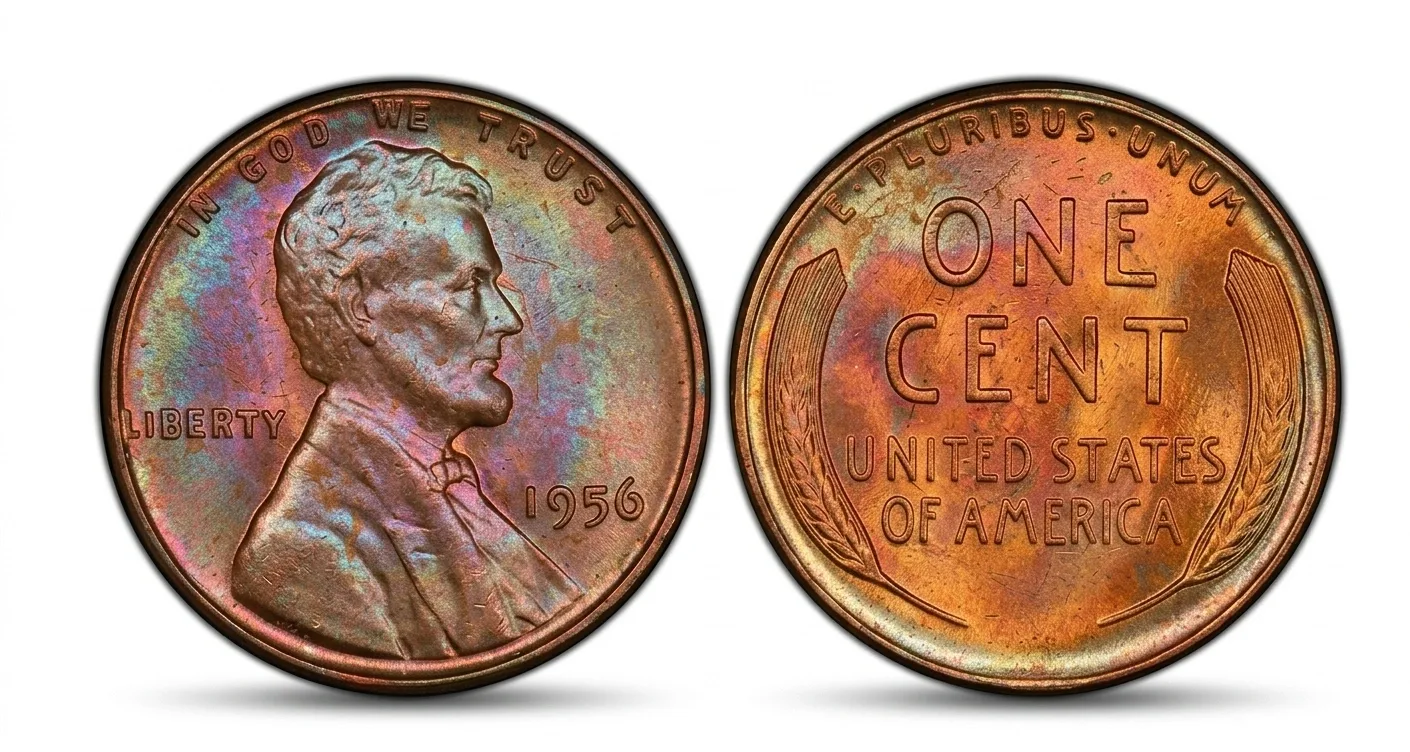
Not every coin needs rarity to matter — sometimes consistency, condition, and subtle mint variations tell a more compelling story than headlines.
This 1956 Wheat Penny represents the final years of the Wheat reverse design before the transition to the Lincoln Memorial motif in 1959.
Mint Location | Mark | Mintage | Base Price MS-63 |
Philadelphia | No mark | 420,748,000 | $2 |
Denver | D | 1,098,201,100 | $1.50 |
Philadelphia (Proof) | PR | 669,384 | $15 |
Denver's production marked the first instance in the series where a single facility exceeded one billion units.
Heavy striking schedules led to rapid deterioration of working dies.
This mechanical stress resulted in numerous micro-variations studied under the coin identifier today.
Technical Specifications: 1956 Lincoln Cent
Relying on physical constants remains essential for verifying authenticity and detecting counterfeits.
Standard parameters for each specimen:
Mass: 3.11 grams
Composition: 95 percent Copper, 5 percent Tin, and Zinc
Diameter: 19.05 mm
Edge: Plain
Weight verification using electronic scales accurate to one-hundredth of a gram is a mandatory step.
Deviations exceeding 0.13 grams indicate potential manufacturing irregularities or non-original blanks.
Grade Analysis and Color Classification
Value for copper coins depends directly on surface oxidation levels.
Color category → Market outcome:
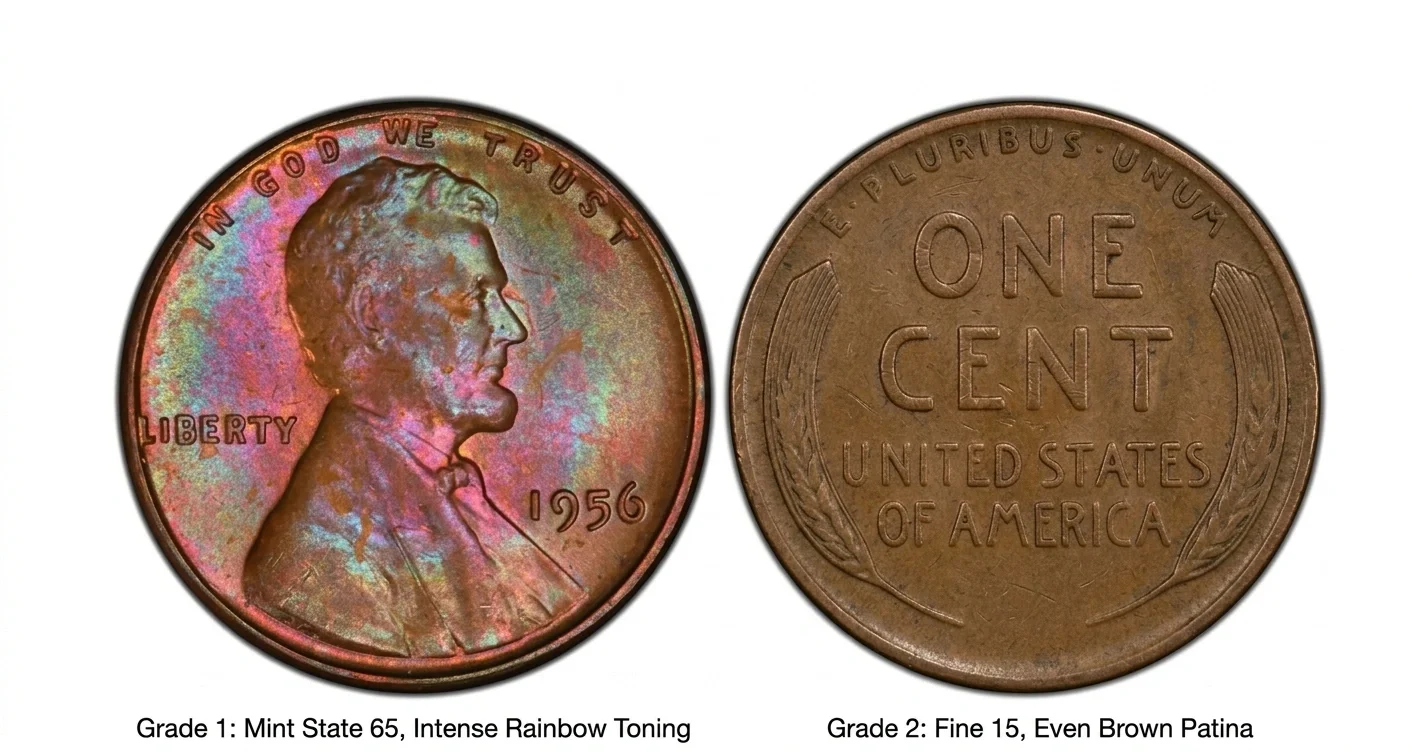
Brown. Oxide film covers over 95 percent of the surface → Minimum premium.
Red-Brown. Original luster remains on 5 to 95 percent of the surface → Moderate price range.
Red. Original mint luster covers 95 percent or more → Maximum market price.
Price gaps between Red and Brown categories in MS-67 grades can reach 400 percent.
Auction Records and Value Trends
Exceptional specimens continue to achieve significant results despite the mass-produced nature of the year.
Verified auction activity:
1956 Philadelphia MS-67+ Red. Sold for $7,050.
1956-D Denver MS-67+ Red. Sold for $5,150.
1956 Philadelphia Proof PR-69 DCAM. Sold for $11,000.
Projected value changes for 2026:
MS-65 positions → Steady 3.5 percent annual growth.
MS-67 positions → 8 percent volatility due to limited supply.
Sub-MS-60 positions → Zero growth caused by market saturation.
Verified Error Varieties and Die Traits
Collector interest in 1956 stems from specific minting defects recognized by professional registries.
Error Type | Visual Identifier | Estimated Price |
D/D RPM | Repunched Denver mint mark | $15–$150 |
Die Break | Cracks appearing on LIBERTY lettering | $5–$25 |
Off-center | 10 to 50 percent image displacement | $40–$300 |
Clipped Planchet | Coin missing a curved edge segment | $15–$60 |
Identifying RPM (Repunched Mintmark) errors requires the best coin identifier app free.
Doubling of the D mark usually occurs in southern or western directions.
Mechanics of the BIE Anomaly
Specific BIE errors occurred frequently during the 1950s production cycle.
Obverse die wear → Vertical crack forming between letters B and E in LIBERTY → Visual imitation of a capital letter I.
Finding a sharp BIE break increases the value of a standard cent by 5 to 10 times.
1956 Proof Strike Characteristics
Proof coins originated only from Philadelphia for inclusion in special sets.
Utilizing polished blanks and double-striking methods ensures a mirrored field.
Contrast levels:
Cameo. Contrast between frosted relief and mirrored fields.
Deep Cameo. Extreme contrast, documented as rare for the 1956 cycle.
Grading statistics:
Approximately 15,000 Proof specimens have been certified.
Fewer than 3 percent of these earned the Deep Cameo designation.
Identification Checklist
Executing this algorithm ensures rapid verification of any 1956 specimen.
Locating the mint mark below the date.
Weighing the coin to 0.01-gram accuracy.
Inspecting for die cracks within lettering.
Categorizing surface color against Red/Brown standards.
Checking for mirrored luster to identify Proof strikes.
Physical impact using tools like an adjustable wrench is strictly forbidden.
Traces of mechanical interference nullify all numismatic value.
Market Environment and Competition
Comparison with 1955 and 1957 issues defines the 1956 market niche.
1955 issues command higher prices due to the famous Double Die error.
1956 issues typically display superior strike quality compared to 1957 units.
Total representation of 1956 coins in Lincoln Wheat portfolios averages 12 percent.